
The "Doctor" in Your Earbuds May Not Be Real: 8 Questions to Ask Before You Trust a Health Podcast
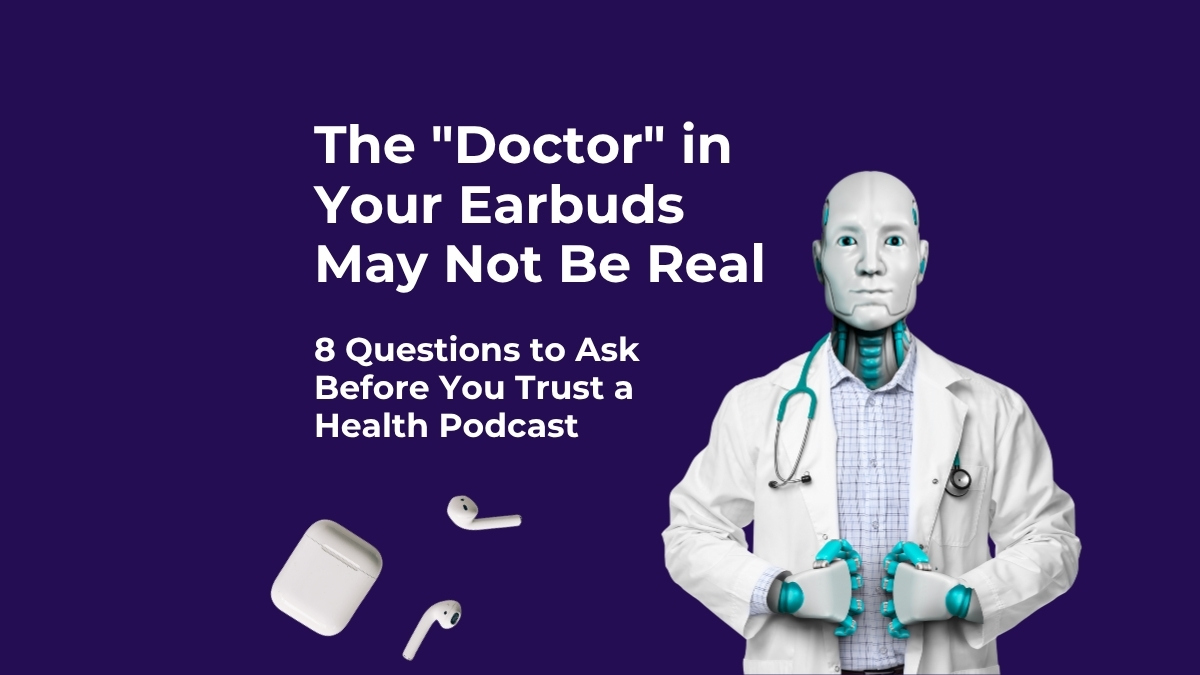
AI-generated characters are calling themselves doctors and giving health advice to vulnerable people — at industrial scale.
I recently posted on LinkedIn and Instagram about something that's really annoying me — to put it nicely. AI-generated health and wellness podcasts are flooding the podcast ecosystem, and everyone needs to pay attention.
This post digs deeper into what I shared there — the specific companies supporting this dangerous slop, the research, and what listeners and creators can do about it.
Twenty Wellness Podcasts in Under 75 Minutes
Inception Point AI, through their Quiet Please Podcast Network, recently pushed out twenty wellness shows in under 75 minutes. The show titles are picked to be optimized for search engines, and include shows like Codependency, Menopause, Burnout Recovery, Panic Attacks, Gambling Addiction, Anxiety Solutions Guide, Mental Health, Measles Return, and Vaccinations.
The company behind these characters has about 11 employees. They have roughly 10,000 active shows and around 300,000 episodes. Inception Point AI itself is led by Jeanine Wright, the former COO of Wondery, an Amazon company, and a current or former board member of several well-known podcast companies.
These shows aren't labeled as entertainment experiments. They're positioned as guidance.
Each of them is "hosted" by AI-generated characters such as "Dr. Mara Lennox" and "Julia Cartwright." There are likely many more shows than the ones I discovered. Inception Point AI has published several thousand new shows (that's shows, not just episodes) in the first months of 2026.
The Codependency show is described as: "Dr. Mara Lennox unpacks codependency with clinical precision and genuine compassion, revealing how childhood wounds create patterns of self-abandonment in adult relationships." The host opens by telling listeners: "I am an AI, which means I can explore sensitive topics like this without personal bias or judgement, and I think that actually serves you better here."
Let that sink in.
An AI character is calling itself "Doctor," telling vulnerable people that the absence of its humanity is a feature, not a bug.
Julia Cartwright, another AI host, describes herself as "an AI health companion with a heart as warm as a Sunday dinner and access to more research than you can shake a thermometer at." She has "more ways to explain complicated health stuff than there are ways to prepare green bean casserole."
Bless her AI heart.
One show, Vaccinations, is a six-part series covering vaccine hesitancy, misinformation, and community outbreaks. Another covers Menopause, with episodes on perimenopause and HRT. Other shows attempt to tackle topics like Burnout Recovery, Anxiety, Measles Return. The list goes on.
Some of these shows link to an Amazon affiliate page recommending organic eggs, lemons, apples, and smoked sockeye salmon. This is a visible breadcrumb indicating what these shows are all about: making money.
Inception Point AI's website proudly declares that they "publish in real time", "scale content infinitely", and "deliver premium quality at ~1/25,000th the cost."
Think they are going to stop with podcasts? No chance. The website reports they "now expanding into short-form video, books & more." They've created social media accounts for these 'influencers', and are promoting a video about "The Next Billion-Dollar Frontier" through AI influencing.
It's easy to understand why healthcare, with it's trillions in annual spending in the US, would be a target for AI-generated content at scale. The audience is massive, the demand for information is constant, and the people searching are often at their most vulnerable.
But these aren't product reviews or travel tips. These are topics where getting it wrong has real consequences. Someone hearing inaccurate or incomplete information about vaccinations may put their child at risk. Someone mismanaging burnout or anxiety based on an AI's confident-sounding guidance could delay getting help they actually need. Someone navigating codependency or addiction is in a moment where the wrong framing can do lasting damage with devastating and permanent repercussions.
Credible publishers of health content including hospitals, medical journals, pharmaceutical companies, and health advocacy organizations, invest heavily in editorial review, medical and legal oversight, and compliance for exactly this reason. They do it because the stakes demand it, and because they're accountable when they get it wrong.
An AI character with a fake medical title has no license to lose, no institution to answer to, no malpractice exposure, and no liability when a listener acts on something it said. The companies producing and distributing this content may not be as insulated from that liability as they think.
Listeners searching for help during some of the most difficult moments of their lives deserve more than a fictional character built to monetize their attention. They deserve real people, real expertise, and real accountability.
The CEO's Own Words
When Podcast Business Journal interviewed Inception Point AI's CEO Jeanine Wright in 2025, she told them that for health and wellness content, "somebody is involved in listening and reviewing the content before it's released."
Wright has compared their model to Wikipedia or Reddit. Those aren't the same thing. Wikipedia spent two decades building up editors, sourcing, and a correction process. Reddit is mostly unmoderated, and bad health information moves through it easily.
Exactly who is involved in "review the content" at Inception Point AI, and their credentials, training, and expertise, is anyone’s guess. Pharmaceutical companies are required to run their promotional content through rigorous medical, legal, and regulatory review before it reaches the public. But without industry-supported standards or platforms, there is no assurance for listeners about the credibility of the health podcasts they find.
The Research Says This Is Dangerous
This isn't a theoretical concern. The research is clear and recent.
A study published in April 2026 in BMJ Open audited five major AI chatbots — including ChatGPT, Gemini, and Grok — across 250 health and medical questions. Nearly half of the responses were rated as problematic by researchers. About 30 percent lacked full context, and nearly 20 percent were considered highly problematic. The error rate was especially high on open-ended questions — the kind people actually ask when they're worried about their health.
Another study published in NEJM AI found that people trusted AI-generated medical advice as much as their own doctor's — even when physicians flagged those same answers as wrong. Participants rated AI responses as more valid, trustworthy, and complete. Even low-accuracy responses scored comparably to real doctors' answers. And participants indicated they would act on that advice.
And a KFF tracking poll from this spring found that uninsured adults were more than twice as likely as insured adults to use AI for mental health advice — 30 percent versus 14 percent. Put plainly: the harder it is for someone to see a real healthcare professional, the more likely they are to let AI play one.
In a time where we continue to see cuts across healthcare and closures of hospitals and pharmacies, the findings of these studies should concern all of us.
What Should You Trust?
Dr. Celine Gounder, an infectious disease specialist and epidemiologist, put it simply in a recent CBS interview. Begin with the host: Is this a real person? Do they have credentials? What institution are they affiliated with?
A trustworthy podcast, she said, is going to have nuance, caveats, limitations — and tell you when to talk to your doctor.
These are practical questions any listener can apply. Here are eight questions that you can ask when considering the source of health podcasts. (Click here to visit my LinkedIn or Instagram posts to help share them more widely)
1. Is this a real person?
A credible host can be verified. Look for articles, profiles, speaking engagements, patients, professional experience.
2. Do they have credentials?
A professional-sounding name isn't a credential. A credible host is transparent about who they are, what their experience is, and where their expertise starts and stops.
3. What institutions or organizations are they affiliated with?
Find where they work, who they're connected to, and what they've done. A fictional character can't be checked.
4. Does the host acknowledge limitations?
Trustworthy health creators include caveats and tell you when something is uncertain, where to find more information, or when to seek medical attention. Be wary of any show that sounds equally certain about everything, every time.
5. Are they citing sources?
Real health podcasters and content creators reference specific studies, guidelines, or experts. AI-generated content tends to make broad claims without attribution - or even fake sources.
6. Do they tell you when to stop listening and seek help?
AI rarely signals doubt, even when doubt is warranted. A credible host tells you when it's time to talk to a healthcare professional.
7. Can you find the show's editorial process? Who reviewed the content? Is there a medical advisor? A production team?
If there's no transparency about how the content was made, be skeptical.
8. Does it sound too polished for what it is?
If a six-part series on a complex medical topic sounds like it was produced overnight — it probably was.
Not every great health podcast is hosted by a doctor — but every credible one is hosted by a real person you can verify. When in doubt, ask your primary care provider, pharmacist, or someone you trust.
What This Means for Creators
If you're a health podcast creator who has spent years developing expertise, researching, interviewing experts, and carefully building trust with your audience — this is what you're now competing against in the feed.
As Dr. Gounder noted in her article, no review process has kept pace with how fast these shows are being made. Right now, no one is required to disclose that a health podcast is AI-generated, and no platform has a process for reviewing this content at scale. The Health Content Integrity Pledge we created is one step toward aligning creators around a set of standards to which they will hold themselves accountable.
All this reinforces the core belief we have at HealthPodcast.org: Sources matter.
Real clinicians, real researchers, real patients sharing real experiences — that's what moves health forward. Not an AI "expert" cranked out in less time than it takes to eat lunch.
And if you're someone looking for health information, you deserve to know who's actually on the other end.
What This Means for Platforms and Distributors
If you're an organization involved in the creation and distribution of health content, you have a responsibility to inform your users and audience whether that content is produced by real people with real expertise or generated by AI.
Right now, AI-generated shows classified as 'health' content sit alongside podcasts from credible creators with real expertise. They are in the same podcast players, with no meaningful distinction for listeners.
That's not a technology problem. That's a choice, and it's one we are working to address through our Health Podcast Library. Every show in the Library goes through a review process that looks at the credentials of the host, the quality of the content, and whether the show meets our credibility standards.
Inclusion in Health Podcast Library signals something to listeners, to creators, and to the organizations that support them: the people behind this content are real, the information is grounded in expertise, and everyone involved is committed to getting it right.
A Challenge to Healthcare
The best answer to AI-generated health podcasts isn't just flagging what's fake. It's elevating and amplifying the voices and insights of credible creators, experts, and organizations that are real.
Hospitals, health systems, medical associations, advocacy organizations, pharmaceutical companies — you have the experts, the research, and the credibility. The microphone is right there. If your clinicians, researchers, and patient advocates aren't podcasting yet, the AI is happy to do it for them. And it already is.
So now that you know what the podcast industry is up to, the question isn't just what are we going to do about it — it's whether healthcare is ready to show up and claim the space before the bots fill it entirely.
Follow our progress, and let's get to work.
Sources and Further Reading
Research Studies:
Tiller, N.B., Marcon, A.R., Zenone, M., et al. (2026). "Generative artificial intelligence-driven chatbots and medical misinformation: an accuracy, referencing and readability audit." BMJ Open, 16(4). https://bmjopen.bmj.com/content/16/4/e112695
Shekar, S., Pataranutaporn, P., Sarabu, C., Cecchi, G.A., & Maes, P. (2025). "People Overtrust AI-Generated Medical Advice despite Low Accuracy." NEJM AI, 2(6). https://ai.nejm.org/doi/abs/10.1056/AIoa2300015
KFF Tracking Poll on Health Information and Trust: Use of AI for Health Information and Advice (March 2026). https://www.kff.org/health-information-trust/poll-1-in-3-adults-are-turning-to-ai-chatbots-for-health-information-equaling-the-share-who-use-social-media-for-health/
Pew Research Center (2026). "Users of social media and AI chatbots for health information are more likely to say they are convenient than accurate." https://www.pewresearch.org/science/2026/04/07/users-of-social-media-and-ai-chatbots-for-health-information-are-more-likely-to-say-they-are-convenient-than-accurate/
Articles and Reporting:
Gounder, C. (2026). "AI Health Podcasts Are Multiplying Faster Than Anyone Can Check Them." https://www.celinegounder.com/p/ai-health-podcasts-no-oversight
Podcast Business Journal (2025). Interview with Jeanine Wright, CEO, Inception Point AI. https://podcastbusinessjournal.com/interviews/jeanine-wright/
Podnews (2026). "AI slop overtakes humans." https://podnews.net/update/ai-slop-overtakes-humans